 7e1fe36c68
OK, this is a big one... I have done this as part of work on Traversable AST, but I believe it has wider benefits, so thought better to spin it off into its own PR. ## What this PR does This PR squashes all nested AST enum types (#2685). e.g.: Previously: ```rs pub enum Statement<'a> { BlockStatement(Box<'a, BlockStatement<'a>>), /* ...other Statement variants... */ Declaration(Declaration<'a>), } pub enum Declaration<'a> { VariableDeclaration(Box<'a, VariableDeclaration<'a>>), /* ...other Declaration variants... */ } ``` After this PR: ```rs #[repr(C, u8)] pub enum Statement<'a> { BlockStatement(Box<'a, BlockStatement<'a>>) = 0, /* ...other Statement variants... */ VariableDeclaration(Box<'a, VariableDeclaration<'a>>) = 32, /* ...other Declaration variants... */ } #[repr(C, u8)] pub enum Declaration<'a> { VariableDeclaration(Box<'a, VariableDeclaration<'a>>) = 32, /* ...other Declaration variants... */ } ``` All `Declaration`'s variants are combined into `Statement`, but `Declaration` type still exists. As both types are `#[repr(C, u8)]`, and the discriminants are aligned, a `Declaration` can be transmuted to a `Statement` at zero cost. This is the same thing as #2847, but here applied to *all* nested enums in the AST, and with improved helper methods. No enums increase in size, and a few get smaller. Indirection is reduced for some types (this removes multiple levels of boxing). ## Why? 1. It is a prerequisite for Traversable AST (#2987). 2. It would help a lot with AST Transfer (#2409) - it solves the only remaining blocker for this. 3. It is a step closer to making the whole AST `#[repr(C)]`. ## Why is it a good thing for the AST to be `#[repr(C)]`? Oxc's direction appears to be increasingly to build up control over the fundamental primitives we use, in order to unlock performance and features. We have our own allocator, our own custom implementations for `Box` and `Vec`, our own `IndexVec` (TBC). The AST is the central building block of Oxc, and taking control of its memory layout feels like a step in this same direction. Oxc has a major advantage over other similar libraries in that it keeps all the AST data in an arena. This opens the door to treating the AST either as Rust types or as *pure data* (just bytes). That data can be moved around and manipulated beyond what Rust natively allows. However, to enable that, the types need to be well-specified, with completely stable layouts. `#[repr(C)]` is the only tool Rust provides to do this. Once the types are `#[repr(C)]`, various features become possible: 1. Cheap transfer of the AST across boundaries without ser/deser - the property used by AST Transfer. 2. Having multiple versions of the AST (standard, read-only, traversable), and these AST representations can be converted to one other at zero cost via transmute - the property used by Traversable AST scheme. 3. Caching AST data on disk (#3079) or transferring across network. 4. Stuff we haven't thought of yet! Allowing the AST to be treated as pure data will likely unlock other "next level" features further down the track (caching for "edge bundling" comes to mind). ## The problem with `#[repr(C)]` It's not *required* to squash nested enums to make the AST `#[repr(C)]`. But the problem with `#[repr(C)]` is that it disables some compiler optimizations. Without `#[repr(C)]`, the compiler squashes enums itself in some cases (which is how `Statement` is currently 16 bytes). But making the types `#[repr(C)]` as they are currently disables this optimization. So this PR essentially makes explicit what the compiler is already doing - and in fact goes a bit further with the optimization than the compiler is able to, in squashing 3 or 4 layers of nested enums (the compiler only does up to 2 layers). ## Implementation One enum "inheriting" variants from another is implemented with `inherit_variants!` macro. ```rs inherit_variants! { #[repr(C, u8)] pub enum Statement<'a> { BlockStatement(Box<'a, BlockStatement<'a>>), /* ...other Statement variants... */ // `Declaration` variants added here by `inherit_variants!` macro @inherit Declaration // `ModuleDeclaration` variants added here by `inherit_variants!` macro @inherit ModuleDeclaration } } ``` The macro is *fairly* lightweight, and I think the above is quite easy to understand. No proc macros. The macro also implements utility methods for converting between enums e.g. `Statement::as_declaration`. These methods are all zero-cost (essentially transmutes). New patterns for dealing with nested enums are introduced: Creation: ```rs // Old let stmt = Statement::Declaration(Declaration::VariableDeclaration(var_decl)); // New let stmt = Statement::VariableDeclaration(var_decl); ``` Conversion: ```rs // Old let stmt = Statement::Declaration(decl); // New let stmt = Statement::from(decl); ``` Testing: ```rs // Old if matches!(stmt, Statement::Declaration(_)) { } if matches!(stmt, Statement::ModuleDeclaration(m) if m.is_import()) { } // New if stmt.is_declaration() { } if matches!(stmt, Statement::ImportDeclaration(_)) { } ``` Branching: ```rs // Old if let Statement::Declaration(decl) = &stmt { decl.do_stuff() }; // New if let Some(decl) = stmt.as_declaration() { decl.do_stuff() }; ``` Matching: ```rs // Old match stmt { Statement::Declaration(decl) => visitor.visit(decl), } // New (exhaustive match) match stmt { match_declaration!(Statement) => visitor.visit(stmt.to_declaration()), } // New (alternative) match stmt { _ if stmt.is_declaration() => visitor.visit(stmt.to_declaration()), } ``` New syntax has pluses and minuses vs the old. `match` syntax is worse, but when working with a deeply nested enum, the code is much nicer - it's shorter and easier to read. This PR removes 200 lines from the linter with changes like this: https://github.com/oxc-project/oxc/pull/3115/files#diff-dc417ff57352da6727a760ec6dee22de6816f8231fb69dbef1bf05d478699103L92-R95 ```diff - let AssignmentTarget::SimpleAssignmentTarget(simple_assignment_target) = - &assignment_expr.left - else { - return; - }; - let SimpleAssignmentTarget::AssignmentTargetIdentifier(ident) = - simple_assignment_target + let AssignmentTarget::AssignmentTargetIdentifier(ident) = &assignment_expr.left else { return; }; ``` |
||
|---|---|---|
| .cargo | ||
| .github | ||
| .vscode | ||
| crates | ||
| editors/vscode | ||
| fuzz | ||
| napi/parser | ||
| npm | ||
| tasks | ||
| wasm/parser | ||
| website | ||
| .git-blame-ignore-revs | ||
| .gitignore | ||
| .ignore | ||
| .taplo.toml | ||
| .typos.toml | ||
| Cargo.lock | ||
| Cargo.toml | ||
| CHANGELOG.md | ||
| cliff.toml | ||
| CONTRIBUTING.md | ||
| deny.toml | ||
| justfile | ||
| LICENSE | ||
| MAINTENANCE.md | ||
| README.md | ||
| rust-toolchain.toml | ||
| rustfmt.toml | ||
| THIRD-PARTY-LICENSE | ||









⚓ Oxc
The Oxidation Compiler is creating a collection of high-performance tools for JavaScript and TypeScript.
Oxc is building a parser, linter, formatter, transpiler, minifier, resolver ... all written in Rust.
🙋Who's using Oxc?
- Rolldown uses the oxc crate for parsing.
- Rspack, Rolldown, and Biome uses the oxc_resolver crate for module resolution.
⚡️ Linter Quick Start
The linter is ready to catch mistakes for you. It comes with 91 rules turned on by default (out of 300 in total) and no configuration is required.
To get started, run oxlint or via npx:
npx oxlint@latest
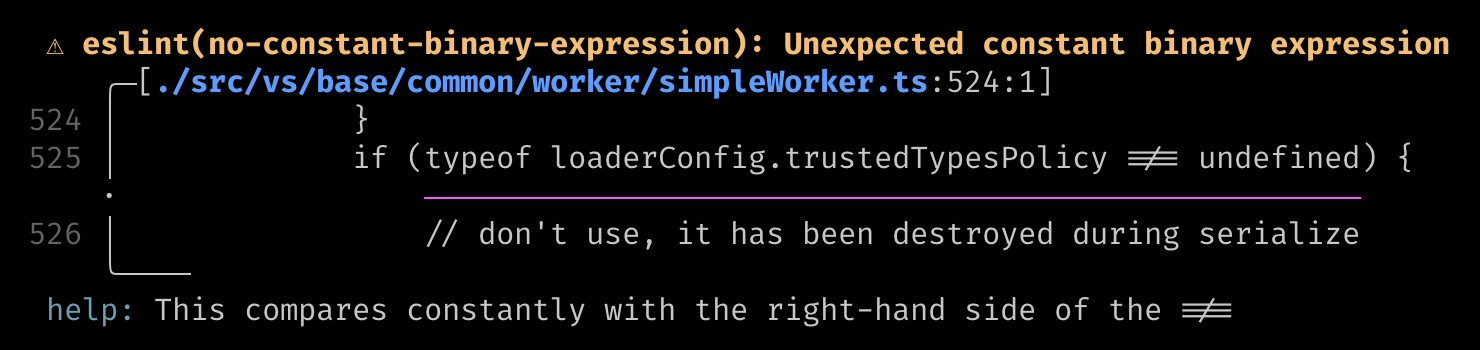
To give you an idea of its capabilities, here is an example from the vscode repository, which finishes linting 4800+ files in 0.7 seconds.
⚡️ Performance
- The parser aim to be the fastest Rust-based ready-for-production parser.
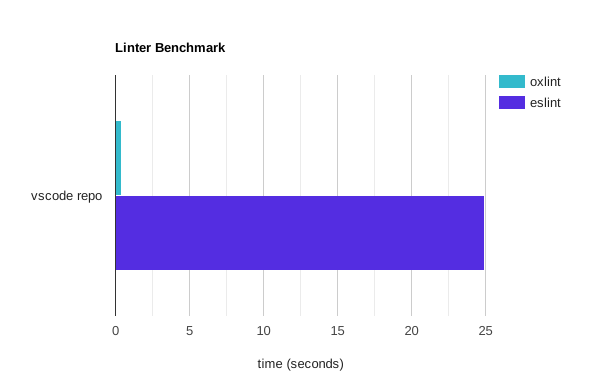
- The linter is more than 50 times faster than ESLint, and scales with the number of CPU cores.
⌨️ Programming Usage
Rust
Individual crates are published, you may use them to build your own JavaScript tools.
- The umbrella crate oxc exports all public crates from this repository.
- The AST and parser crates oxc_ast and oxc_parser are production ready.
- The resolver crate oxc_resolver for module resolution is also production ready.
- Example usages of these crates can be found in their respective
crates/*/examplesdirectory.
While Rust has gained a reputation for its comparatively slower compilation speed, we have dedicated significant effort to fine-tune the Rust compilation speed. Our aim is to minimize any impact on your development workflow, ensuring that developing your own Oxc based tools remains a smooth and efficient experience.
This is demonstrated by our CI runs, where warm runs complete in 3 minutes.
Node.js
- via napi: oxc-parser
Wasm
🎯 Tools
🔸 AST and Parser
Oxc maintains its own AST and parser, which is by far the fastest and most conformant JavaScript and TypeScript (including JSX and TSX) parser written in Rust.
As the parser often represents a key performance bottleneck in JavaScript tooling, any minor improvements can have a cascading effect on our downstream tools. By developing our parser, we have the opportunity to explore and implement well-researched performance techniques.
While many existing JavaScript tools rely on estree as their AST specification, a notable drawback is its abundance of ambiguous nodes. This ambiguity often leads to confusion during development with estree.
The Oxc AST differs slightly from the estree AST by removing ambiguous nodes and introducing distinct types.
For example, instead of using a generic estree Identifier,
the Oxc AST provides specific types such as BindingIdentifier, IdentifierReference, and IdentifierName.
This clear distinction greatly enhances the development experience by aligning more closely with the ECMAScript specification.
🏆 Parser Performance
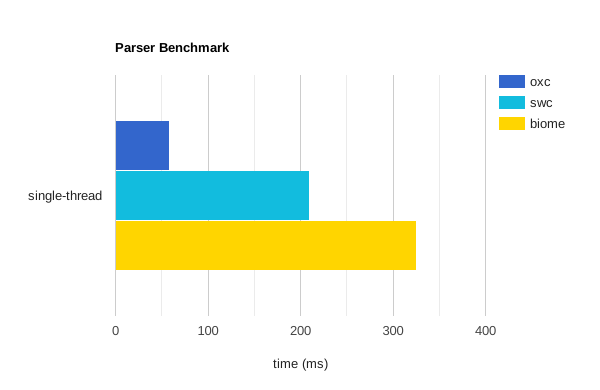
Our benchmark reveals that the Oxc parser surpasses the speed of the swc parser by approximately 3 times and the Biome parser by 5 times.
How is it so fast?
- AST is allocated in a memory arena (bumpalo) for fast AST memory allocation and deallocation.
- Short strings are inlined by CompactString.
- No other heap allocations are done except the above two.
- Scope binding, symbol resolution and some syntax errors are not done in the parser, they are delegated to the semantic analyzer.
🔸 Linter
The linter embraces convention over configuration, eliminating the need for extensive configuration and plugin setup. Unlike other linters like ESLint, which often require intricate configurations and plugin installations (e.g. @typescript-eslint), our linter only requires a single command that you can immediately run on your codebase:
npx oxlint@latest
🏆 Linter Performance
The linter is 50 - 100 times faster than ESLint depending on the number of rules and number of CPU cores used. It completes in less than a second for most codebases with a few hundred files and completes in a few seconds for larger monorepos. See bench-javascript-linter for details.
As an upside, the binary is approximately 5MB, whereas ESLint and its associated plugin dependencies can easily exceed 100.
You may also download the linter binary from the latest release tag as a standalone binary, this lets you run the linter without a Node.js installation in your CI.
How is it so fast?
- Oxc parser is used.
- AST visit is a fast operation due to linear memory scan from the memory arena.
- Files are linted in a multi-threaded environment, so scales with the total number of CPU cores.
- Every single lint rule is tuned for performance.
🔸 Resolver
Module resolution plays a crucial role in JavaScript tooling, especially for tasks like multi-file analysis or bundling. However, it can often become a performance bottleneck. To address this, we developed oxc_resolver.
The resolver is production-ready and is currently being used in Rspack and Rolldown. Usage and examples can be found in its own repository.
🔸 Transformer (Transpiler)
A transformer is responsible for turning higher versions of ECMAScript to a lower version that can be used in older browsers. We are currently focusing on the architecture. See Milestone 1 for details.
🔸 Minifier
JavaScript minification plays a crucial role in optimizing website performance as it reduces the amount of data sent to users, resulting in faster page loads. This holds tremendous economic value, particularly for e-commerce websites, where every second can equate to millions of dollars.
However, existing minifiers typically require a trade-off between compression quality and speed. You have to choose between the slowest for the best compression or the fastest for less compression. But what if we could develop a faster minifier without compromising on compression?
We are actively working on a prototype that aims to achieve this goal, by porting all test cases from well-known minifiers such as google-closure-compiler, terser, esbuild, and tdewolff-minify.
Preliminary results indicate that we are on track to achieve our objectives. With the Oxc minifier, you can expect faster minification times without sacrificing compression quality.
🔸 Formatter
While prettier has established itself as the de facto code formatter for JavaScript, there is a significant demand in the developer community for a less opinionated alternative. Recognizing this need, our ambition is to undertake research and development to create a new JavaScript formatter that offers increased flexibility and customization options.
The prototype is currently work in progress.
✍️ Contribute
See CONTRIBUTING.md for guidance.
Check out some of the good first issues or ask us on Discord.
If you are unable to contribute by code, you can still participate by:
- Add a GitHub Star to the project.
- Join us on Discord.
- Follow me on twitter and tweet about this project.
📚 Learning Resources
- My small tutorial on how to write a JavaScript Parser in Rust
- My small article Pursuit of Performance on Building a JavaScript Compiler
- And more
🤝 Credits
This project was incubated with the assistance of these exceptional mentors and their projects:
- Biome - @ematipico
- Ruff - @charliermarsh, @MichaReiser
- quick-lint-js - @strager
- elm-review - @jfmengels
📖 License
Oxc is free and open-source software licensed under the MIT License.
Oxc ports or copies code from other open source projects, their licenses are listed in Third-party library licenses.