 4bc3f5a884
These set of changes attempt to resolve a few complexities from the original implementation: sizing and how to dynamically update the content in the list. On the sizing front, manually specifying the width and height of the rows felt like it was more complex than measuring the first widget and using that for all other widgets. This allows a user who wants to force an explicit size to use the Resize widget, while also supporting SizeToFit flows. Additionally, this paves the way for us to add horizontal scrolling to this list, but this commit was already complex enough I held off on that change for now. One workflow I wanted to see supported was going from 0 rows to 50 rows. When the item count comes from a trait, it was pretty complicated to determine how to tell the list to ask for a new row count. By having the user provide a Value<usize>, they can provide a `Dynamic<usize>` that can be updated with a new row count whenever the application determines there is new data. We still need to figure out a way to force a refresh of the data even if the row count doesn't change. Ultimately changing this allowed removing the trait and seemingly simplified the basic usage in addition to adding more flexibility. |
||
|---|---|---|
| .github/workflows | ||
| .rustme | ||
| assets | ||
| cushy-macros | ||
| examples | ||
| guide | ||
| src | ||
| .crate-docs.md | ||
| .gitignore | ||
| Cargo.lock | ||
| Cargo.toml | ||
| CHANGELOG.md | ||
| CODE_OF_CONDUCT.md | ||
| CONTRIBUTING.md | ||
| LICENSE-APACHE | ||
| LICENSE-MIT | ||
| README.md | ||
| rustfmt.toml | ||
Cushy




Cushy is an experimental Graphical User Interface (GUI) crate for the Rust
programming language. It features a reactive data model and aims to enable
easily creating responsive, efficient user interfaces. To enable easy
cross-platform development, Cushy uses its own collection of consistently-styled
Widgets.
Cushy is powered by:
Kludgine, a 2d graphics library powered by:winitfor windowing/inputwgpufor graphicscosmic_textfor text layout + rasterization
palettefor OKLab-based HSL color calculationsarboardfor clipboard supportfiguresfor integer-based 2d math
Getting Started with Cushy
The Widget trait is the building block of Cushy: Every user
interface element implements Widget. The Widget trait
documentation has an overview of how Cushy works. A list of built-in
widgets can be found in the cushy::widgets module.
Cushy uses a reactive data model. To see an example of how reactive data models work, consider this example that displays a button that increments its own label:
fn main() -> cushy::Result {
    // Create a dynamic usize.
    let count = Dynamic::new(0_isize);

    // Create a new label displaying `count`
    count
        .to_label()
        // Use the label as the contents of a button
        .into_button()
        // Set the `on_click` callback to a closure that increments the counter.
        .on_click(move |_| count.set(count.get() + 1))
        // Run the application
        .run()
}
Here are some ways to learn more about Cushy:
-
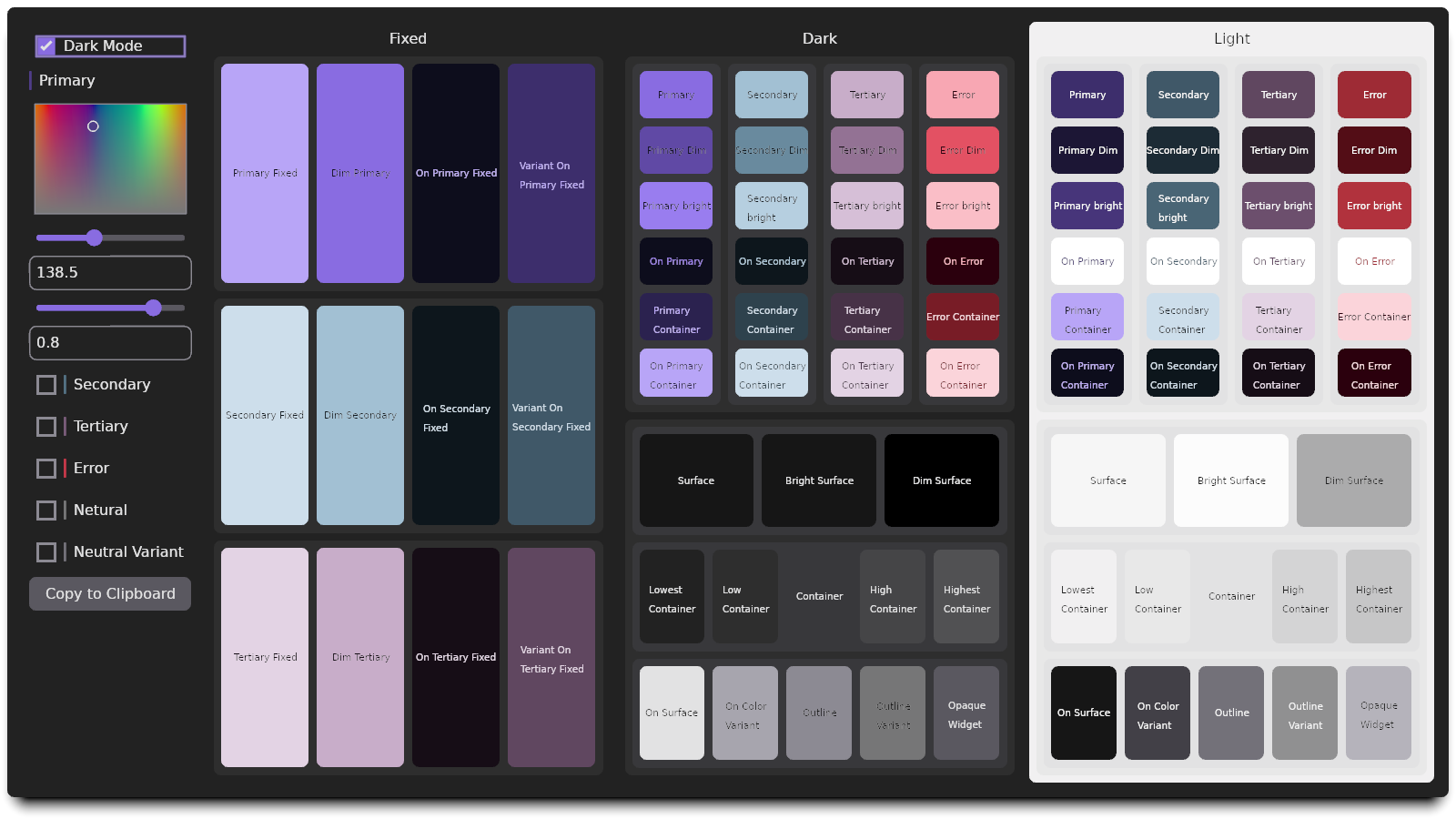
Explore the examples directory. Nearly every feature in Cushy was initially tested by creating an example. Many are focused on demonstrating a single feature, but there are some complex example such as a theme editor/previewer:
-
Browse the user's guide. The user guide is a work in progress, but features CI-generated screenshots and animations for its examples:

-
Ask questions in Discussions or on Discord.
Project Status
This project is early in development, but is quickly becoming a decent framework. It is considered alpha and unsupported at this time, and the primary focus for @ecton is to use this for his own projects. Feature requests and bug fixes will be prioritized based on @ecton's own needs.
If you would like to contribute, bug fixes are always appreciated. Before working on a new feature, please open an issue proposing the feature and problem it aims to solve. Doing so will help prevent friction in merging pull requests, as it ensures changes fit the vision the maintainers have for Cushy.
Open-source Licenses
This project, like all projects from Khonsu Labs, is open-source. This repository is available under the MIT License or the Apache License 2.0.
To learn more about contributing, please see CONTRIBUTING.md.